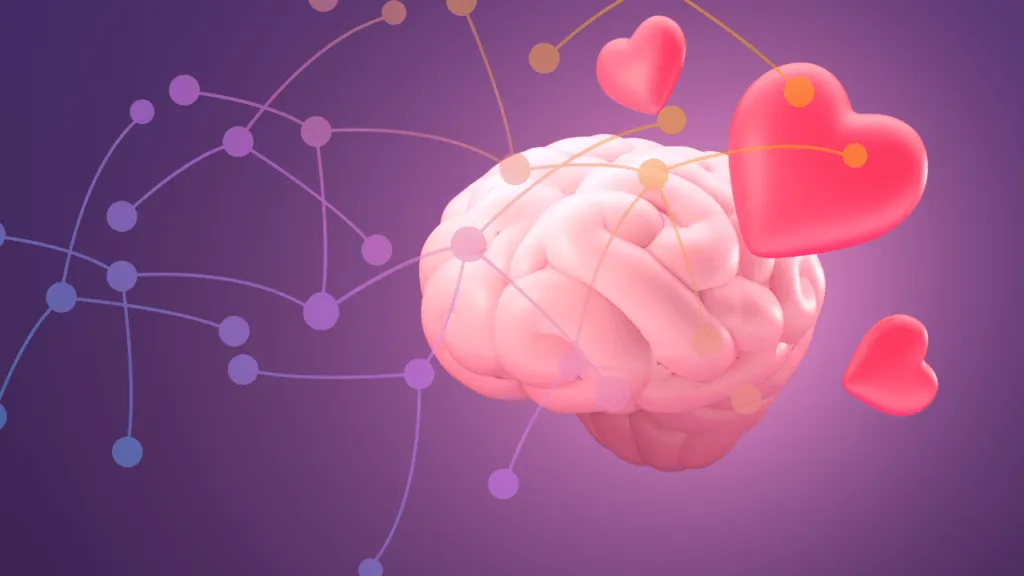
When you fall in love, your brain runs a specific chemical program. The racing pulse, the obsessive thinking, the inability to eat: these are not metaphors. They are the measurable effects of five neurochemicals doing exactly what evolution shaped them to do.
The five doing the work:
Dopamine creates reward and craving. The same circuits that respond to food and gambling light up when you think about them. This is why you cannot stop.
Oxytocin is released through touch, eye contact, and sex. It builds trust, emotional attunement, and the slow warmth of long partnership.
Vasopressin supports long-term pair bonding and shows up in committed relationships in ways it does not in casual ones.
Phenylethylamine (PEA) is an endogenous amphetamine. It produces the high of early love.
Norepinephrine gives you racing heart, sweaty palms, and sleeplessness.
Together they explain why early love is physically destabilizing, and why withdrawal from a serious relationship can feel like drug withdrawal. Chemically, it kind of is.
Two things worth knowing. First: the chemistry shifts over time. New love runs on dopamine and norepinephrine, high arousal and obsessive focus. Long-term partnership runs on elevated oxytocin and quieter dopamine: calm, trust, being known. That shift is not love dying. It is a chemical graduation to a different kind of intensity.
Second: "love is blind" is literally true. Brain imaging shows that viewing a partner's photo cranks up reward signals while quieting regions associated with critical judgment. Your brain is simultaneously running the attraction signal and dimming the red-flag detector. Not a moral failing. A measurable neural pattern.
None of this tells you whether to stay. The mechanism does not dictate the meaning. Love is both utterly biological and something you decide what to do with.
When you fall in love, your brain runs a specific chemical program. The hyper-focus, the obsessive thinking, the racing pulse, the inability to eat — those aren’t metaphors. They’re the measurable downstream effects of about five neurochemicals doing exactly what evolution shaped them to do. Knowing what’s happening doesn’t ruin it. It does help explain why new love feels different from long love, why heartbreak hurts the way it does, and why “love is blind” turns out to be physically true.
The five chemicals doing the work
Five compounds are doing most of the heavy lifting:
- Dopamine — the reward chemical. Creates excitement and craving. Why you can’t stop thinking about them. Same system that lights up for cocaine, food, and slot machines.
- Oxytocin — the bonding hormone. Released during hugging, kissing, sex, and meaningful eye contact. Builds trust, empathy, and the slow warmth of long attachment.
- Vasopressin — the long-term-attachment hormone. Promotes monogamous behavior in pair-bonding species and shows up in committed human partnerships.
- Phenylethylamine (PEA) — endogenous amphetamine. Creates the “high” feeling of new love.
- Norepinephrine — fight-or-flight chemistry. Racing heart, sweaty palms, sleeplessness, the inability to focus on anything but them.
This cocktail explains why early love feels intense to the point of being physically destabilizing, and why withdrawal from a serious relationship can feel like actual drug withdrawal — because chemically, it kind of is.
The pathways, for the technically curious
If you want the specific brain systems:
- Dopaminergic system — VTA (ventral tegmental area) projecting to nucleus accumbens drives reward-seeking. This is the same loop active in addiction (Aron et al., 2005).
- Oxytocinergic pathways — hypothalamic-pituitary axis regulates trust and pair bonding (Carter, 2017).
- Vasopressinergic circuits — species-specific V1a receptor distribution correlates with monogamous behavior. Prairie voles and meadow voles differ on a few receptor genes, and that small genetic difference is enough to make one species monogamous and the other not (Young & Wang, 2004).
- Serotonergic modulation — serotonin drops in early-stage love, producing OCD-like symptoms. This is why new love feels obsessive — chemically, it shares signatures with obsessive-compulsive disorder (Marazziti & Canale, 2004).
fMRI shows that passionate love, companionate love, and parental love activate distinct but overlapping circuits. Different kinds of love look different on a brain scan. Same machinery, different patterns of activation.
Why “love is blind” is literally true
Brain imaging gives the cliché its receipts. When people view photos of a romantic partner:
- The caudate nucleus lights up — reward, motivation.
- Activity decreases in regions associated with critical judgment and social assessment.
Translation: your brain is simultaneously cranking up reward signals and turning down the part that notices red flags. Not a moral failing — a real, measurable neural pattern. This is partly why friends can see what you can’t see during the first six months of a relationship.
Six kinds of love, six neural signatures
A 2024 Aalto University study mapped distinct neural patterns for six different types of love using fMRI:
- Romantic love — most intense, with dramatic reward-center activation (VTA, nucleus accumbens). Falls in the same category as hunger and thirst — a biological drive, not just a feeling.
- Parental love — overlaps with romantic love but engages additional caregiving and protection regions. Some of the most ancient circuitry in the mammalian brain.
- Companionate love — the deep, stable affection of long-term partnership. The reward-center fireworks calm down; social cognition and emotional regulation regions become more prominent. This is what it looks like when chemistry settles into something more durable.
- Friendship — engages social cognition centers (medial prefrontal cortex, temporoparietal junction).
- Compassion for strangers — uses social-cognition regions plus areas tied to empathy.
- Love for pets and nature — yes, this lights up real bonding circuitry, not a metaphor.
Machine learning could predict which type a person was experiencing from their brain scan alone. Love isn’t one thing in the brain any more than it’s one thing in language.
New love versus long love: a different chemistry
The reason new love feels different from a ten-year partnership isn’t just that you “got used to” them. The chemistry actually shifts:
- New lovers show elevated dopamine and norepinephrine — high arousal, hyper-focus, sleeplessness.
- Long-term couples show elevated baseline oxytocin and quieter dopaminergic activity — calm, trust, the felt-safety of being known.
A 2024 NeuroImage hyperscanning study found that romantic partners show greater neural synchrony than close friends, particularly in the prefrontal cortex — the region responsible for emotional regulation. Long love isn’t the absence of intensity. It’s a different kind of intensity, with a different signature.
How attachment shows up in the brain
Adult attachment styles (secure, anxious, avoidant — see Psychology of Love) have distinct neural signatures:
- Secure — balanced activation across connection and self-regulation circuits. The body can be vulnerable without panicking.
- Anxious — heightened amygdala activity. The threat-detection system is always running, scanning for signs of rejection. This is why people with anxious attachment misread neutral texts as withdrawal.
- Avoidant — reduced activation in emotional-processing regions. A protective pattern from early experiences when emotional needs went unmet — the brain learned to dial connection-needs down.
Attachment style is stable but not fixed. Brain imaging confirms that “earned security” — developing secure attachment in adulthood through therapy or a healthy partner — produces measurable changes in these circuits.
What this means in practice
Three things, all useful:
- The early-love crazies are real and they’re temporary. Sleeplessness, obsession, can’t-eat — that’s elevated norepinephrine and dropping serotonin. It doesn’t last. Don’t make permanent decisions while running this chemistry.
- Chemistry settling isn’t love dying. The shift from new love’s dopamine fireworks to long love’s oxytocin calm is a chemical promotion, not demotion. Different molecules, different feeling, same person.
- Connection is biologically necessary, not optional. Long-term studies consistently show that strong social bonds are among the best predictors of happiness, health, and longevity. Loneliness measurably affects mortality risk. Love isn’t a luxury; it’s infrastructure.
What science doesn’t answer
None of this tells you whether to stay. None of it tells you whether this relationship is the right one. The mechanism doesn’t dictate the meaning. Knowing that oxytocin builds bonds is useful; it doesn’t tell you whether the bond you have is the one you want to keep building.
Love is both utterly biological and something you decide what to do with. The chemistry is real. So is the choice.
The feeling of falling in love is one of the most distinctive states humans experience. It also happens to be one of the most studied. Decades of neuroimaging, hormonal assays, and behavioral research have produced a detailed map of what is happening in the brain during love's different phases. The map does not explain everything. It does make the experience considerably less mysterious.
The five chemicals
Five compounds do most of the work in romantic love.
Dopamine activates the reward-motivation system. The ventral tegmental area (VTA) and nucleus accumbens, the core dopaminergic reward circuit, light up when people view photos of a romantic partner at the same intensity they respond to food, cocaine, and gambling (Aron et al., 2005). The craving, the inability to think about anything else, the compulsive feeling: this is dopamine doing its job, which is to make you pursue something the brain has tagged as highly valuable.
Oxytocin is released through physical touch, hugging, kissing, sex, and meaningful eye contact. Its effects include increased trust, emotional attunement, and reduction of social anxiety. Carter (2014) has shown that oxytocin pathways are central to the evolution of pair bonding in social mammals, including humans. Oxytocin is also what builds the slow warmth of long partnership: the felt-safety of being genuinely known by another person.
Vasopressin supports long-term attachment and is particularly implicated in the biology of monogamous pair bonding. Young and Wang (2004) demonstrated that the distribution of V1a vasopressin receptors differs between monogamous and non-monogamous vole species, and that this difference maps onto a small number of receptor-gene variations. The implications for human pair bonding remain an active research area.
Phenylethylamine (PEA) functions as an endogenous amphetamine. It contributes to the high energy, reduced need for sleep, and expansive feeling of early love. Its effects are strongest in the early months and tend to fade as a relationship matures.
Norepinephrine produces the physiological symptoms most people associate with new love: racing heart, sweaty palms, difficulty sleeping, inability to concentrate on anything else. This is the fight-or-flight system recruited for a decidedly different purpose.
Beyond those five, one more compound matters precisely because it moves in the opposite direction. Serotonin drops rather than rises in early love. Marazziti and Canale (2004) measured serotonin-transporter levels in people within the first six months of intense romantic love and found them reduced to a degree comparable with what is seen in obsessive-compulsive disorder. This is the most likely mechanism behind love's intrusive, can't-stop-thinking-about-them quality: early love is not metaphorically obsessive, it is neurochemically obsessive, sharing a measurable signature with OCD. As the relationship stabilizes over the following months, serotonin drifts back toward baseline and the intrusive quality softens, which is one reason the obsessive phase is self-limiting rather than permanent.
Together, these chemicals explain why early love is physiologically destabilizing, and why the end of a serious relationship can produce withdrawal-like symptoms. Helen Fisher's imaging work with people who had recently been rejected found that viewing photos of the ex still activated the dopaminergic reward system, alongside regions tied to craving and loss, months after the breakup — the same circuitry implicated in substance addiction and its withdrawal. The neurochemistry of attachment grief overlaps substantially with the neurochemistry of addiction withdrawal; the parallel is not rhetorical but anatomical.
The brain regions involved
Aron et al. (2005) conducted the foundational fMRI study, placing people in early-stage intense romantic love inside scanners and showing them photos of their partners. The results: strong activation in the VTA and caudate nucleus (reward and motivation), and reduced activation in regions associated with critical social judgment and threat detection.
The practical implication: your brain is simultaneously running reward signals at maximum and turning down the red-flag detector. "Love is blind" is not a cliche. It is a measurable neural pattern that typically lasts the first six months to two years of intensive romantic infatuation. This is partly why close friends can see things about a new partner that the person in love genuinely cannot.
Six types of love, six neural signatures
A 2024 Aalto University study published in Cerebral Cortex used fMRI and machine learning to identify distinct neural patterns for six types of love: romantic love, parental love, companionate love, friendship, compassion for strangers, and love for pets and nature. Machine learning could predict which type a person was experiencing from their brain scan alone.
The most important finding: romantic love and parental love activate distinct but overlapping circuits. Different kinds of love use the same hardware but produce different patterns of activation. Love is not one thing in the brain, any more than it is one thing in language.
New love versus long love
The reason new love and a ten-year partnership feel so different is that the chemistry actually shifts, not just the emotional temperature.
New romantic love is characterized by elevated dopamine and norepinephrine: high arousal, obsessive thought, reduced sleep, heightened aliveness. Long-term partnership is characterized by elevated oxytocin and quieter dopaminergic activity: calm, security, trust, the deep felt-safety of being known.
A 2024 hyperscanning study using fMRI found that romantic partners show greater neural synchrony than close friends in prefrontal regions responsible for emotional regulation. Long love is not the absence of intensity. It is intensity with a different signature, doing different work.
The common mistake is to read the shift from dopamine intensity to oxytocin calm as love losing power. A more accurate description: the chemistry graduated. What it was doing in the early phase, which was orienting you toward this person and motivating you to pursue them, is done. What it is doing now is maintaining a different kind of bond. Both are doing exactly what they are supposed to do.
Attachment in the brain
Adult attachment styles, which develop from early caregiver experiences, have distinct neural signatures that show up in relationship contexts. Securely attached adults show balanced activation across connection and self-regulation circuits. Anxiously attached adults show heightened amygdala activity: the threat-detection system runs chronically elevated, scanning for signs of rejection even in safe relationships. Avoidantly attached adults show reduced activation in emotional-processing regions: the result of a nervous system that learned to minimize connection-seeking because expressing it produced no reliable response.
Attachment style is stable but not fixed. Brain imaging confirms that "earned security," the development of secure attachment in adulthood through therapy or sustained relationship with a secure partner, produces measurable neural changes. The pattern that was learned early can be updated.
What the science does not answer
None of this tells you whether to stay in a particular relationship, or whether the one you have is the right one. The mechanism does not dictate the meaning. Knowing that oxytocin builds bonds does not tell you whether the bond you have is the one worth keeping.
Three practical implications that are honest:
The early-love intensity is real and it is temporary. Making permanent decisions while running high dopamine and low serotonin is roughly comparable to making permanent decisions while jet-lagged and slightly euphoric. You can do it. It is not the ideal condition.
The chemistry settling is not love ending. The shift from dopamine fireworks to oxytocin warmth is a chemical transition, not a loss. Different molecules, different feeling, the same person.
Connection is biologically necessary. Long-term studies consistently show that strong social bonds are among the best predictors of health and longevity. Loneliness measurably increases mortality risk (Holt-Lunstad et al., 2015). Love is not a luxury. It is infrastructure.