When articles say "studies show," they don't tell you which kind of study, on whom, measuring what. There are five main methods behind love research, and each one can only answer certain questions.
fMRI scans measure blood flow in the brain while someone looks at a photo of their partner. It can tell you which regions activate — the caudate nucleus and ventral tegmental area show up consistently — but not what the experience feels like or what causes it.
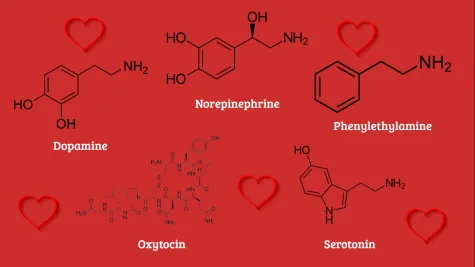
Hormone assays measure oxytocin, dopamine metabolites, and serotonin in blood or saliva. A 2004 study by Marazziti and Canale found new lovers had serotonin levels similar to people with OCD — the obsessive-thinking phase has a measurable biochemistry. Hormones describe the engine, not the destination.
Prairie vole studies use a naturally monogamous rodent to study pair-bonding genetics under controlled conditions. Larry Young's work at Emory University identified the vasopressin V1a receptor as central to bond formation. The limitation: humans have a lot more built on top of that basic machinery.
Gottman's longitudinal couple studies followed thousands of couples for decades, coding their conflict interactions minute by minute. Four behavioral patterns — criticism, contempt, defensiveness, stonewalling — predict relationship dissolution with roughly 90% accuracy from a 15-minute conversation sample.
Cross-cultural research surveys mate preferences across many societies. William Jankowiak and Edward Fischer's 1992 review of 166 cultures found evidence of romantic love in 89% of them. David Buss's 37-culture study found it ranked as a top mate preference universally.
The four research traditions — neurochemical, attachment, evolutionary, and social neuroscience — are complementary. The most credible claims about love are supported across more than one of them.
The honest summary from the field: we know a lot about the machinery, less about the meaning, and almost nothing about what makes a specific relationship last forty years. The good studies say so.
Most popular articles about love cite “studies show…” without telling you what kind of study, on whom, measuring what. If you want a working sense of which claims have receipts, it helps to know what the actual research looks like.
Here’s a short tour of the five main methods behind the science of love — and what each one can and can’t tell you.
1. fMRI: looking at the brain while it loves
Functional magnetic resonance imaging measures changes in blood flow in the brain as a proxy for neural activity. In love research, fMRI scans are typically run while subjects look at photos of their partner versus a neutral acquaintance, or while they think about being in love.
What it can show: which brain regions activate during specific emotional experiences. Landmark studies have identified the caudate nucleus and ventral tegmental area (VTA) as particularly active when people view photos of romantic partners — the same regions involved in addiction.
What it can’t show: what the experience feels like, or whether activation differences are causes or effects. fMRI tells you “this lit up” — it doesn’t tell you “this is what causes love.”
Notable work: Bianca Acevedo’s 2012 study found that couples in 20-year happy marriages showed brain activation patterns similar to new lovers when viewing their partner — long love can keep the early-love circuitry warm.
2. Hormone and neurochemical assays
Researchers measure oxytocin, vasopressin, cortisol, dopamine metabolites, and other compounds in blood, saliva, and urine to correlate hormonal state with relationship state.
What it can show: measurable differences in baseline hormone levels between people in new love versus long love versus single life. The 2004 Marazziti & Canale study famously found that new lovers had serotonin levels matching people with OCD — physical confirmation that the obsessive thinking phase isn’t just metaphor.
What it can’t show: the meaning of love. Hormones tell you about the engine; they don’t tell you about the trip.
3. Animal models — especially the prairie vole
Prairie voles are one of the very few mammals that form lifelong monogamous pair bonds. Their nearly-identical cousins, meadow voles, do not. This makes them a controlled-conditions natural experiment in the genetics and neurobiology of attachment.
What it can show: the role of vasopressin V1a receptor distribution in pair-bonding behavior. Researchers can manipulate vole brain chemistry (genetically, pharmacologically) and observe whether the bond forms or doesn’t. This is how we know the V1a receptor matters at all — you can’t do that experiment ethically in humans.
What it can’t show: how vole biology maps to the much more complicated picture in humans. The basic machinery looks similar; everything built on top of it (culture, language, choice) is uniquely human.
4. Longitudinal couple studies — the Gottman “Love Lab”
John Gottman and colleagues followed thousands of couples for decades, recording their interactions in a laboratory and then tracking which marriages survived. By coding the moment-to-moment behaviors during conflict, Gottman could predict divorce with reported accuracy of around 90% based on a 15-minute conversation.
What it can show: behavioral patterns that predict relationship outcomes. The famous “Four Horsemen” — criticism, contempt, defensiveness, stonewalling — predict relationship dissolution far better than personality compatibility or even reported satisfaction.
What it can’t show: what’s happening internally during those moments — that requires combining behavioral coding with physiological measures (heart rate, cortisol, etc.), which Gottman did but which most popularizations leave out.
5. Cross-cultural and evolutionary studies
Anthropologists comparing behavior across many cultures look for universal patterns that suggest evolved adaptations versus culturally variable patterns that suggest learned behavior.
What it can show: that romantic love isn’t a Western or modern invention. It’s been documented in essentially every culture ever studied. David Buss’s cross-cultural mate-preference research surveyed 37 cultures and found “mutual attraction and love” ranked as a top mate preference in all of them.
What it can’t show: why it’s universal — that requires linking it to neurobiology and evolutionary theory, which has to be done carefully because evolutionary “just-so stories” are easy to make up and hard to test.
The major research traditions
Most contemporary work fits into one of four frameworks:
- Neurochemical models — dopamine reward, oxytocin/vasopressin bonding, serotonin regulation. (Fisher, 2016)
- Attachment neuroscience — integrating Bowlby’s attachment theory with brain imaging. (Hazan & Diamond, 2000; see Psychology of Love)
- Evolutionary psychology — sexual selection and parental investment models. (Buss, 2019; see Evolution of Love)
- Social neuroscience — mirror neuron systems, empathy networks, neural synchrony between bonded partners. (Cacioppo et al., 2012)
These aren’t competing camps. They’re complementary lenses, and the strongest claims about love are the ones supported across multiple frameworks.
What to do with this
When you read a love-science claim in the wild:
- “Studies show oxytocin is the love hormone” — usually overstated. Oxytocin is one part of a network, and the popular framing ignores cases where it produces in-group favoritism rather than warm fuzzies.
- “Couples in love have synchronized brain activity” — true (2024 NeuroImage hyperscanning study) but the effect is modest and contextual.
- “Love lights up the same brain regions as cocaine” — true and misleading. They share reward circuitry. They are not the same experience.
- “Brain scans can detect if someone is really in love” — overstated. They can detect that something is going on; the inference back to a felt experience is much harder than headlines suggest.
The honest summary: we know a lot about love’s machinery, less about love’s meaning, and almost nothing about what makes a specific relationship survive forty years. The good studies are humble about that.
If you want to go deeper
The resource list at Evolutionary Biology of Love — reading & viewing is a good entry point. For neurobiology specifically, The Neurobiology of Love NCBI review is the single best free starting point.
The problem with "studies show"
Most popular writing about love research compresses a highly varied set of methods into a single phrase. What that hides matters, because different methods can only answer different questions, and the limitations of each are substantial.
Method 1: fMRI — what the brain does while it loves
Functional magnetic resonance imaging measures the BOLD signal: Blood Oxygen Level Dependent changes in neural tissue. When a brain region becomes more active, it consumes more oxygen, triggering local increases in blood flow. fMRI detects these flow changes as a proxy for neural activity. The temporal resolution is slow — changes are captured on the order of seconds — while actual neural events happen in milliseconds.
In love research, standard fMRI protocols show participants photos of their romantic partner alternating with photos of a neutral acquaintance. Subtracting the neural responses isolates regions that respond specifically to the partner.
The landmark studies by Helen Fisher, Arthur Aron, and colleagues found that the caudate nucleus and ventral tegmental area (VTA) activate consistently when people view romantic partners. The VTA is a hub of the dopaminergic reward system — the same circuitry active in anticipating any reward, including addictive substances. This is the empirical basis for the "love is like an addiction" framing.
Bianca Acevedo's 2012 study in Social Cognitive and Affective Neuroscience extended this work to long-term relationships. Couples in happy marriages of 20 years showed VTA and caudate activation patterns similar to people who had recently fallen in love, challenging the assumption that neurochemical passion inevitably fades with time.
Two significant limitations apply to all fMRI love research:
Reverse inference: identifying a brain region as active during an emotion does not prove that region causes the emotion, or that it specifically processes it. The VTA activates for many kinds of reward anticipation. Inferring "this is romantic love" from a VTA activation requires additional converging evidence.
Ecological validity: lying still in a scanner while looking at photographs is not how relationships actually function. The activation patterns observed may or may not reflect what happens during real-world moments of connection or conflict.
Method 2: Hormone and neurochemical assays
Researchers measure levels of oxytocin, vasopressin, cortisol, testosterone, and dopamine metabolites in blood, saliva, and urine. This allows correlation studies between hormonal state and relationship state.
The most frequently cited example is the 2004 study by Donatella Marazziti and Domenico Canale, published in Psychological Medicine. They found that people in the early stages of romantic love had serotonin transporter levels significantly lower than both control subjects and people who had been in longer relationships. Crucially, their serotonin profiles were statistically similar to those of patients with obsessive-compulsive disorder. The study was small — 20 participants in the love group — but the finding has been replicated in direction if not always in magnitude.
Oxytocin is the most misrepresented chemical in popular love science. Research by Markus Heinrichs and colleagues at the University of Freiburg, and subsequent work by Carsten De Dreu, found that oxytocin does not produce undifferentiated warmth or bonding. It enhances connection with in-group members while simultaneously increasing defensiveness or suspicion toward out-group members. Oxytocin can make someone feel more attached to their partner while being more hostile toward perceived threats at the same time. The "love hormone" label collapses this complexity into something it is not.
Hormone assays describe biochemical states that accompany love. They do not establish what the subjective experience is like, and they cannot resolve whether the hormone causes the love state or the love state causes the hormone change.
Method 3: Animal models — the prairie vole
Prairie voles (Microtus ochrogaster) are among the roughly 3–5% of mammal species that form long-term monogamous pair bonds. Meadow voles (Microtus pennsylvanicus) are nearly genetically identical but do not pair-bond. This natural variation makes prairie voles a valuable controlled-conditions model.
The key finding, developed primarily by Larry Young and Zuoxin Wang at Emory University and published in Nature Neuroscience in 2004, involves the vasopressin V1a receptor (AVPR1A). Prairie voles have significantly more V1a receptors in reward-related brain regions than meadow voles. When researchers manipulate V1a receptor expression — either genetically or pharmacologically — they can induce or prevent pair-bonding behavior in a way that is directly observable and replicable.
This is the strongest causal evidence for any specific mechanism in mammalian attachment biology. The limitation is the transfer problem: prairie voles do not have a prefrontal cortex of comparable complexity to humans, no language, no cultural frameworks for relationships, no capacity to stay together through boredom or conflict by choosing to. The basic attachment machinery appears conserved across mammalian evolution. Everything humans build on top of that is not accessible through vole research.
Method 4: Longitudinal couple studies
John Gottman's laboratory at the University of Washington followed thousands of couples from the 1970s onward, bringing them into a fully instrumented apartment to live for a weekend or to discuss a conflict while being recorded by multiple cameras. A behavioral coding system called SPAFF — the Specific Affect Coding System — catalogued every verbal and nonverbal behavior during conflict interactions, synchronized with physiological measures: heart rate, skin conductance, blood velocity, and salivary cortisol.
The best-known finding: four behavioral patterns predict relationship dissolution with reported accuracy approaching 90% from a 15-minute conflict conversation sample. Gottman called these the Four Horsemen: criticism (attacking the partner's character rather than the behavior), contempt (communicating disgust or superiority), defensiveness (rejecting responsibility for one's contribution to a problem), and stonewalling (emotional withdrawal from the interaction).
The 90% accuracy figure requires context. It comes from trained coders applying SPAFF to recorded conflict conversations, not from a simple self-report survey. The physiological data proved equally important: Gottman found that physiological flooding — when heart rate exceeds approximately 100 bpm during conflict — was as predictive as behavioral coding. When the body is in a flooded state, the capacity for rational problem-solving shuts down regardless of intention or commitment.
Longitudinal studies are the closest thing love research has to ground truth. Their limitation is that they cannot establish clean causation, and observer effects — the presence of recording equipment, the artificiality of the lab setting — may alter the behaviors being studied.
Method 5: Cross-cultural and evolutionary research
The foundational cross-cultural study for romantic love was published by William Jankowiak and Edward Fischer in 1992 in the journal Ethnology. Reviewing ethnographic data from 166 cultures, they found evidence of romantic love in 147 of them — 89%. In the remaining cultures, they argued, absence was more likely a gap in ethnographic documentation than genuine absence of the phenomenon.
David Buss's 1990 survey of mate preferences across 37 cultures found mutual attraction and love ranked as a top preference universally, though its importance relative to other qualities varied. More recent studies have extended this work to 90 countries and tens of thousands of participants with consistent results.
The methodological challenge for cross-cultural research is category translation. Does the word or concept translated as "love" in each language correspond to the same psychological experience? Western survey instruments may import cultural assumptions that distort comparisons. Evolutionary explanations face the additional challenge of unfalsifiability: the counterfactual cannot be run, and post-hoc evolutionary narratives are easy to generate for almost any observed behavior.
Why converging methods matter
The most defensible claims in love research are supported across multiple methods. The involvement of dopaminergic reward circuitry in romantic love rests on fMRI evidence (VTA and caudate activation), neurochemistry (dopamine metabolites), and animal models (prairie vole reward circuit manipulation). That convergence makes the claim credible in a way no single method could establish.
Claims resting on a single study, a single method, or a single species should be held more lightly. The oxytocin-as-love-hormone framing fails the multi-method test: the hormone assay evidence is more complex than the label implies, and cross-species evidence suggests context-dependence rather than universal warmth.
The reproducibility issue
Psychology has faced a significant reproducibility crisis since approximately 2011, when large-scale replication projects found that many classic findings did not replicate at their original effect sizes. Love research is not immune. Some frequently cited studies in this field have small samples — 20 participants or fewer — which means estimated effect sizes are noisy and replication uncertain.
The most robust findings tend to come from large-sample neuroimaging meta-analyses or longitudinal behavioral studies with thousands of participants followed across years. Single small studies, however elegant in design, should be treated as hypothesis-generating rather than conclusive.
The honest summary: the field knows a substantial amount about love's machinery, considerably less about love's meaning, and almost nothing about what makes a specific relationship survive forty years. The studies worth trusting are the ones that say so.