
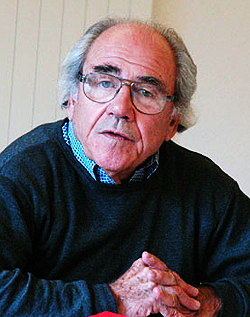
In the landscape of postmodern philosophy, few thinkers have dissected the nature of contemporary love as provocatively as Jean Baudrillard. The French philosopher, best known for his theories of simulation and hyperreality, turned his analytical lens toward one of humanity’s most cherished experiences — love — and discovered something unsettling: what we think we’re pursuing may no longer exist.
Love as simulation: chasing copies without originals
Baudrillard’s most radical claim about love emerges from his seminal work Simulacra and Simulation. He argues that our contemporary understanding of romantic love has become divorced from any authentic reality, replaced instead by what he calls “simulacra” — copies without originals.
Consider the modern quest for the “perfect relationship.” Baudrillard suggests this pursuit is fundamentally shaped by media representations, cultural narratives, and social expectations that have created an idealized version of love that never existed in the first place. We’re not seeking real love; we’re chasing the simulation of love — a hyperreal construct that exists only in our collective imagination.
This creates what Baudrillard terms “hyperreality” — a condition where the simulation becomes more real than reality itself. The romantic comedy meet-cute, the Instagram-perfect couple, the fairy-tale wedding — these representations don’t reflect real love, but they have become the standard against which all real relationships are measured and inevitably found wanting.
The linguistic betrayal: “I love you” as infidelity
Perhaps Baudrillard’s most haunting observation about love concerns language itself. He writes:
If you say, “I love you,” then you have already fallen in love with language, which is already a form of break up and infidelity.
This statement cuts to the heart of postmodern anxiety about representation. The moment we attempt to capture love in words, we’ve already betrayed the immediate, lived experience of loving. Language, rather than conveying feeling, becomes a substitute for it. The declaration “I love you” doesn’t express love — it replaces love with its representation.
This linguistic betrayal operates on multiple levels:
- Language is always inadequate to the complexity of emotional experience
- The act of speaking love transforms a private, internal reality into a public, social construct
- Once love is spoken, it becomes subject to the logic of communication — interpretation, misunderstanding, manipulation
Seduction versus love: the feminine art of signs
In Seduction, Baudrillard draws a crucial distinction between two modes of romantic engagement — and this isn’t merely about gender dynamics. It’s about fundamentally different ways of relating to reality and meaning.
Seduction, which Baudrillard associates with the “feminine” principle (though not exclusively with women), operates through signs, symbols, and playful manipulation of meaning. It creates reality through performance and suggestion rather than seeking to uncover some hidden truth. Seduction is about the game itself — the dance of appearance and concealment that generates its own meaning.
Direct sexual desire, coded as “masculine,” operates under the illusion that it can access something “real” and authentic. It seeks to penetrate surface appearances to reach genuine connection or truth. But Baudrillard argues this search for authenticity is itself trapped in simulation — there is no “real” to be discovered beneath the play of signs.
The power of seduction lies in its acknowledgment that all human interaction is mediated by symbols and representations. Rather than lamenting this condition, seduction embraces it, finding freedom and creativity in the endless play of meaning.
The impossibility of authentic love
Baudrillard’s analysis leads to a disturbing conclusion: in our media-saturated age, authentic love may have become impossible. We’re so thoroughly immersed in representations of love that we can no longer distinguish between the real thing and its simulation. More troubling still, the “real thing” may never have existed independently of its representations.
This doesn’t mean Baudrillard advocates cynicism or the abandonment of romantic relationships. Instead, he’s diagnosing a condition of contemporary existence that we must understand if we hope to navigate it consciously. When we recognize that our desires are shaped by simulations, we can begin to relate to love differently — perhaps more playfully, less desperately, with greater awareness of the constructed nature of our romantic ideals.
Living with simulation: implications for modern relationships
What does Baudrillard’s analysis mean for how we approach love today?
First, it suggests the importance of questioning our romantic assumptions. When we find ourselves disappointed that our relationships don’t match media representations, we might ask whether we’re pursuing something that never existed.
Second, Baudrillard’s work points toward the value of embracing the artifice inherent in all human relationships. Rather than seeking some impossible authenticity, we might find freedom in acknowledging that love, like all human experiences, is always already mediated by culture, language, and representation.
Finally, his philosophy suggests that the most honest approach to love might be one that embraces its fundamentally performative nature. If all love involves the play of signs and symbols, perhaps we can find genuine connection through conscious participation in this play rather than through the futile attempt to escape it.
The radical freedom of recognizing simulation
Ultimately, Baudrillard’s philosophy of love offers a kind of radical freedom. By recognizing that our romantic ideals are simulations, we’re liberated from the impossible task of achieving them. We can approach love as a creative practice rather than a search for truth, as an ongoing performance rather than a final destination.
This perspective doesn’t diminish the intensity or importance of romantic experience. Instead, it relocates the source of meaning from some external standard to the conscious creation of shared reality between two people. In a world where all reference points have become simulations, the act of creating meaning together becomes both more important and more possible.
Baudrillard’s insights into love remain deeply relevant in our age of social media, online dating, and constant exposure to curated representations of romantic happiness. By understanding how simulation operates in our romantic lives, we can begin to forge more conscious, creative, and ultimately satisfying relationships — not in spite of artifice, but through the conscious embrace of our fundamentally symbolic nature.
This exploration of Baudrillard’s philosophy of love reveals how postmodern thinking can illuminate contemporary romantic experience. While his analysis may seem pessimistic, it ultimately offers tools for more conscious and creative approaches to love in an age of simulation.